Why Your Church Needs a
Digital Ministry Platform in 2026
And Why That Matters More Than You Think
I am wary of the language of urgency when it comes to technology and the Church, because the Church’s real urgency has never been about platforms or software. It has always been about people. People who are lonely. People who are seeking. People who showed up once and were never followed up with because no one had a system for remembering. The Gospel does not need a better app. It needs faithful hands to carry it.
So I want to say that plainly at the outset, before the statistics arrive and the case builds, because I think you deserve to know where I stand before I ask you to consider anything. I build ministry tools for a living. But more honestly, I am someone who has watched pastors weep from exhaustion that has nothing to do with the Gospel and everything to do with the machinery around it. Someone who has sat in small churches where the volunteer coordinator is also the worship leader, the youth group driver, and the person who forgot to update the website three months ago.
This piece is not a sales pitch dressed in theological language. It is a genuine attempt to ask a question I think matters: what if the right tools could free you to do the work you were actually called to do?
That question deserves honest data, real stories, and theological grounding. So here they are.
The Monday Morning Silence
There is a particular kind of silence that settles over a church office on a Monday morning, when the echoes of Sunday have barely faded and already the emails are multiplying like loaves and fishes, only without the miracle. You know the silence I mean. It sits between the stack of attendance cards no one has entered, the prayer requests scrawled on scraps of paper, and the Bible study notes you meant to distribute last Thursday. It is the silence of a shepherd who loves the flock and is slowly drowning in the administration of loving them well.
Perhaps you recognise it. Perhaps you are sitting in it right now.
I believe, with the quiet ferocity of long conviction, that technology ought to serve the Church the way a good trellis serves a vine: invisibly, structurally, so the living thing can do what living things were made to do.
Grow.
The Ground Has Shifted Beneath Us
Something rather extraordinary has happened in the last two years, and it would be a disservice not to name it plainly. The Church is growing again. Not everywhere, not uniformly, but in ways that caught even the researchers off guard. According to the Barna Group and Pushpay’s 2026 State of Church Technology report, 95% of church leaders now affirm that technology opens new opportunities for ministry, whilst 94% say it actively helps their church fulfil its mission in today’s digital culture. [1] These are not aspirational numbers. They are the testimony of over 1,300 leaders surveyed in late 2025, and they represent a seismic shift from even five years ago.
But here is what strikes me most. The conversation has moved. It is no longer whether churches should use digital tools. That debate, mercifully, is behind us. The question now, as Barna frames it, is how intentionally churches align those tools with their mission. [1] Not adoption, but alignment. Not efficiency, but faithfulness.
That distinction matters profoundly, because it means we are no longer talking about technology as a concession to modernity. We are talking about it as an instrument of discipleship.
The Numbers That Tell a Story
Consider what has unfolded. Church management software adoption has climbed to 86% of congregations, with mobile app usage now at 67%. [2] Four in five church leaders say technology has made ministry life easier, and 91% report it helps them better care for their community. [1] Livestreaming, which surged out of pandemic necessity, has held remarkably steady, with 86% of churches continuing to stream services even as in-person attendance rebounds. [2] Younger generations, meanwhile, are not merely tolerating the digital dimension of church life; they are leading it. Millennials are twice as likely to join a church that prioritises technology as part of its mission. [2]
And then there is the quiet revolution in Scripture engagement. Over 80% of people who attend church both in person and online read their Bibles regularly, compared to 66% of those who attend only in person. [3] Two-thirds of Bible users now access Scripture digitally. [4] Bible engagement among Millennials grew by 9% in a single year, the largest generational increase recorded. [4] For the first time since 2021, overall Bible use in America has actually increased, with ten million more adults reading Scripture outside of church. [4]
These are not the numbers of a Church in retreat. These are the numbers of a Church waking up.
What Does Faithfulness Look Like Now?
Paul wrote to the Corinthians that he had become all things to all people, that by all possible means he might save some. 1 Cor 9:22 There is a principle nested inside that apostolic restlessness which speaks directly to the Church’s relationship with technology: faithfulness is not static. It adapts. It meets people where they are, in the language they speak, through the doorways they actually walk through.
In 2026, those doorways are increasingly digital. Not exclusively. Never exclusively. The incarnation insists on presence, on bodies gathered, on bread broken and wine poured in the same room. But the incarnation also insists on meeting people in their ordinary, daily reality, and that reality now includes phones and screens and the quiet moments at 11pm when someone finally has the courage to type a prayer they could not say aloud.
A digital ministry platform is not a replacement for the gathered church. It is an extension of it. A way of carrying the conversation past the carpark, past the Sunday smile, into the Tuesday struggle and the Thursday doubt and the Saturday loneliness that no one mentions over morning tea.
What a Platform Actually Does
Let me speak practically, because theology without hands and feet is just theory.
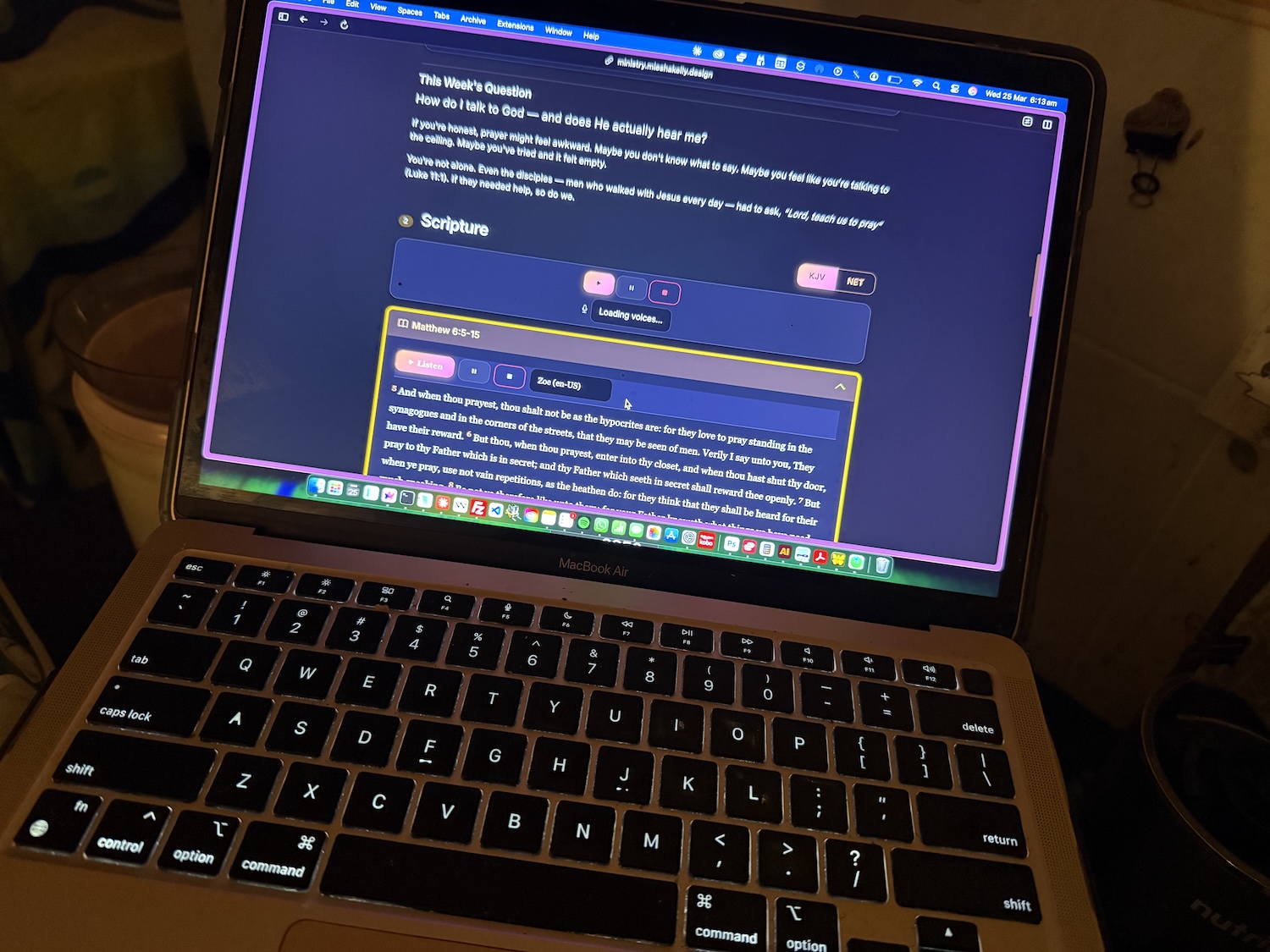
A well-designed ministry platform, like Elohvie, gathers the scattered pieces of church life into a single, coherent place. Bible studies with built-in Scripture lookup and audio, so leaders do not need to spend hours formatting handouts. Sermon archives searchable and accessible, so the Word preached on Sunday can still be doing its work on Wednesday. Event management that does not require a spreadsheet, three email threads, and someone’s personal phone. Member care tools that allow a pastor to hold pastoral notes with the tenderness and confidentiality they deserve, without relying on memory alone. Discipleship pathways that guide new believers through structured growth, because not everyone knows what to read next after the initial fire of conversion.
For the individual believer, a platform like this becomes a personal sacred space. A journal. A reading plan. A Bible with search and audio and bookmarks. A place to sit with a study at your own pace, in your own darkness or your own light, and let the Word do what the Word does.
“Your word is a lamp for my feet, a light on my path.” Ps 119:105 Digital tools do not change what the lamp is. They simply make it possible to carry it into rooms it could not otherwise reach.
Stories from the Field
The Barna and Pushpay research identified a striking subset of churches they call “high-missional technology” congregations, roughly one in four churches where digital tools are not merely operational but woven into the fabric of discipleship, worship, and community. These churches see significantly stronger participation from Gen Z and Millennials, and their leaders are nearly twice as likely to view technology’s primary purpose as reaching people with the Gospel or strengthening community. [1] Remarkably, 60% of leaders in these churches report effectiveness in fostering a reliance on the Holy Spirit for guidance, a 35-point difference compared to churches with low missional technology alignment. [1]
That last statistic is worth pausing over. The churches most intentionally using technology are also the ones most attuned to the Spirit. Technology is not pulling them away from dependence on God; it is freeing them to lean in further, because the administrative burden has been lightened and the relational infrastructure has been strengthened.
Consider the small rural church, the one with sixty people on a good Sunday, which represents the median congregation in America. [3] These churches often lack dedicated IT staff, communication teams, or even a reliable website. Yet their need for connection, discipleship, and administrative support is just as urgent as any megachurch’s, perhaps more so, because the pastor is doing everything. A platform designed with this reality in mind does not add complexity. It removes it. It gives the bivocational pastor a single tool instead of seven makeshift ones. It gives the home Bible study leader a way to create structured studies without a theology degree or a graphic design budget.
Churches across denominations have discovered that digitising their records, streamlining their communication, and offering online discipleship resources does not diminish the human touch. Quite the opposite. When the machinery works quietly in the background, the people doing ministry can actually look up from their desks and see the faces in front of them.
The Quiet Revolution in Bible Engagement
One of the most significant developments in recent years, and one that deserves far more attention than it receives, is the explosion of digital Bible engagement. Twenty-one percent of adults now use apps or websites for Scripture reading. [4] Among those who engage digitally, 59% turn to Bible apps as their primary tool. [3] Bible sales are up over 40% since 2022, and spiritual app downloads have risen nearly 80% since 2019. [5]
And here is the detail that caught my heart: 25% of those who identify as “nones,” people with no religious affiliation, report curiosity about the Bible or Jesus. Fifty-six percent of all Americans express that same curiosity. [4]
These are people standing at a threshold, and they will not cross it by walking into a church building first. Many of them will cross it through a screen, through a study they stumble upon at midnight, through a devotional that finds them in the algorithm or arrives because someone shared a link. The harvest is plentiful, Matt 9:37 and some of it is ripening in digital fields we have barely begun to cultivate.
A ministry platform with a built-in Bible, structured studies, and public-facing devotional content is not a luxury for the technologically ambitious. It is a net cast wide for precisely the people Jesus spent His ministry pursuing: the ones who had not yet arrived.
The Incarnational Imperative
I use that phrase deliberately. If we believe, as the Scriptures teach, that God folded eternity into human skin and walked among us, John 1:14 then we must take seriously the ordinary, physical, daily reality of the people we serve. And that reality, in 2026, includes a digital dimension that is not going away. To refuse engagement with it is not purity. It is absence. It is choosing not to be present in the spaces where people actually live their Monday-to-Saturday faith.
The early church did not build elaborate temples first and hope people would come. They met in homes. They wrote letters. They used the roads Rome had built for empire to carry a Gospel the empire could never contain. They were, in a word, adaptive. Not because their message changed, but because their love for people demanded they go where the people were.
We are in precisely that moment again.
The 2026 Barna research introduces a new framework: “missional technology,” the degree to which a church’s digital tools serve not just operations but discipleship, worship, and community. [1] The churches that score highest on this measure are not the ones with the biggest budgets or the sleekest websites. They are the ones where technology serves the mission with theological intentionality.
That is the invitation. Not to become a tech church. To become a church where technology quietly, faithfully, invisibly supports the real work: knowing Christ, making Him known, and caring for one another along the way.
Why Now?
Because the ground is shifting, and it is shifting toward us. Church engagement has stabilised for the first time in over a decade. [2] Young adults are returning. [5] Bible engagement is rising. [4] Curiosity about Jesus is at remarkable levels even among the unchurched. [4] Communication remains the number one challenge ministry leaders hope technology can address, [2] which means the need is known and felt, not theoretical.
And because the cost of inaction is not neutral. It is not that churches without digital platforms stay the same. They fall behind, slowly, in their capacity to connect, to follow up, to disciple, to be present in the lives of their people between Sundays. The gap between a church that uses technology intentionally and one that does not is widening, and it is widening in the areas that matter most: engagement, pastoral care, and reaching the next generation.
Elohvie eMinistry was built for exactly this moment. Not as a replacement for anything sacred, but as a tool, a trellis, a digital extension of the gathered community that helps churches do what churches have always done: worship, study, serve, and love. It was built for the pastor who needs one platform instead of seven. For the Bible study leader who wants structured studies without the hassle. For the individual believer who wants to grow in faith with intention and community.
For the church that believes the Gospel is worth carrying into every room, even the ones made of pixels and light.
Building the Room
I said at the beginning that this was not a sales pitch, and I meant it. But it is an invitation.
If you are a pastor, a ministry leader, a small group coordinator, or simply someone who loves their church and wants to see it flourish, I would gently invite you to consider what a digital ministry platform could free you to do. Not more. Free. What pastoral conversations could you have if the administration were handled? What studies could you offer if the tools were already built? What people could you reach if the door were open at midnight as well as Sunday morning?
“For where two or three gather in my name, there am I with them.” Matt 18:20
He is there. In the gathering. In the scattering. In the screen glow and the sanctuary hush. In every room we build for His name, digital or otherwise, Christ is present.
The question is not whether He will show up.
The question is whether we will build the room.
• • •
Elohvie eMinistry is a digital ministry platform for churches and faith communities of every size. Explore what it offers at elohvie.com, and discover whether it might serve your community’s next season of growth.
Sources
1. Pushpay and Barna Group, “Technology for Missional Impact: State of Church Technology 2026,” March 2026. Based on a nationally representative survey of 1,306 U.S. church leaders conducted November–December 2025. Available at barna.com/research/church-technology-mission/
2. Pushpay, “2025 State of Church Technology Report,” May 2025. Survey of over 1,700 U.S. church leaders. Presented in partnership with Checkr. Available at hub.pushpay.com/state-of-church-technology/
3. Subsplash, “The Future of Faith: 100 Church Tech Trends for Pastors in 2026,” citing the Faith Communities Today 2023 study and Pew Research data. Available at subsplash.com/blog/100-must-know-facts-about-technology-church-trends
4. American Bible Society, “2025 State of the Bible Report,” 2025. Annual study of Bible engagement, attitudes, and behaviours among U.S. adults. Cited via Subsplash and Pushpay reports.
5. Carey Nieuwhof, “7 Disruptive Church Trends That Will Rule 2026,” CareyNieuwhof.com, January 2026. Citing Barna Group data on faith commitment, Bible sales, spiritual app downloads, and Christian music streams. Available at careynieuwhof.com/church-trends-2026/